Projects

What we are working on now, with papers, posters and code where they are available.

Active

Motion Forge

Active

Motion Forge

Humanoid robots that learn agile moves by playing tag against each other.

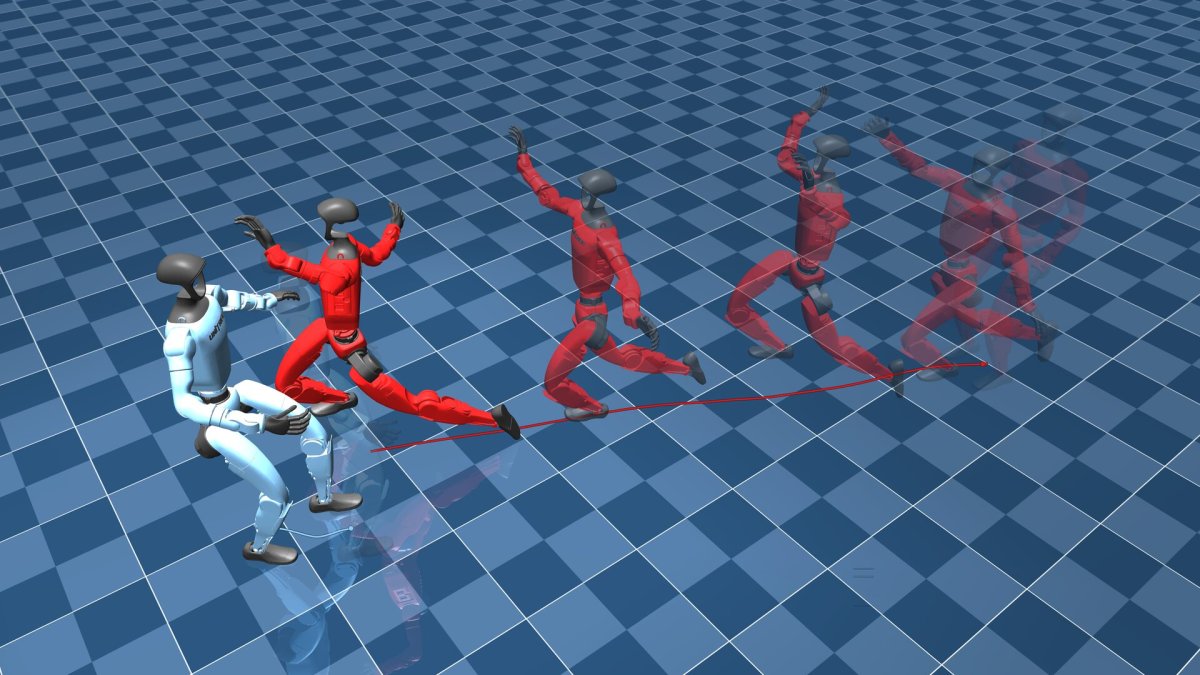
Motion Forge asks whether competition can teach robots new ways to move. Most locomotion controllers learn from a carefully shaped reward or by imitating reference motions, and they stop improving once they have mastered it. In MJTag, our first environment, two Unitree G1 humanoids play tag in the MuJoCo physics simulator, and one role-conditioned policy learns to play both pursuer and evader from a nearly sparse win-or-lose reward. The learner trains against a league of its own past checkpoints, chosen with Prioritized Fictitious Self-Play so it always faces opponents it can still learn from. An adaptive role sampler keeps the game balanced, because chasing is much easier than escaping. Over 40,000 rounds of play (3.9 billion simulation steps), the controller keeps finding new strategies, including sprinting, lunging, dodging and diving.

People: Nathan Hogg
Papers

BeLA

Active

BeLA

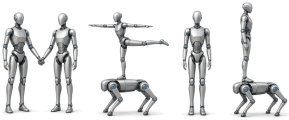
Behavior is a Language: one model for controlling many different robot bodies.

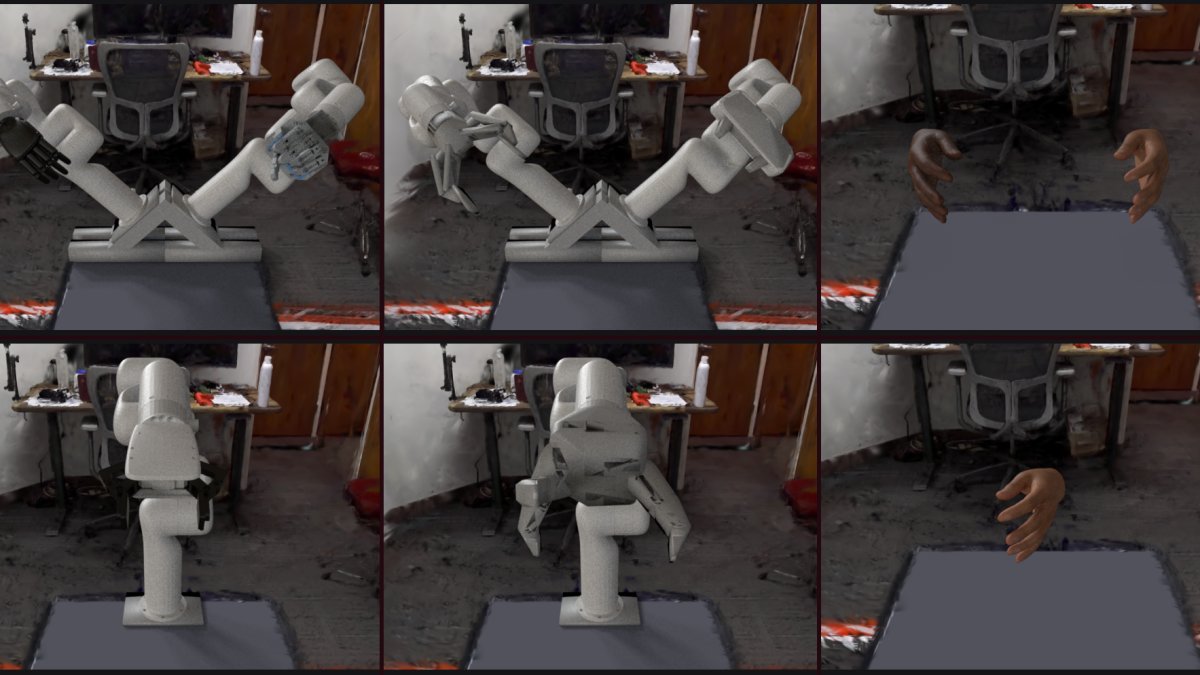
BeLA is a cross-attention model that learns how motion primitives differ from one robot to another, so a single model can control many embodiments. It breaks robot state into tokens built from learned factors (body part, property, and reference frame), tags each by its role as an observation, goal, or prompt, and denoises actions from a shared latent space. Users can mix and match control modes. We train and test in the Genesis physics engine, with Gaussian-splat renderings of our real lab behind the scene, across four mounting platforms, 11 end effectors, single-arm and bimanual robots, and human hands. Training on a more diverse mix of embodiments raises success rates on a block-lifting task.

People: Matt Hyatt, Griffen Lee, Nathan Hogg

Papers

Active

QuICP

Letting autonomous vehicles see beyond their line of sight by sharing point clouds.

An autonomous vehicle can only perceive what its own sensors can see. QuICP lets nearby vehicles share the point clouds they capture, so the ego vehicle can merge their observations with its own and detect obstacles that are hidden from its view. Shared point clouds are aligned with Iterative Closest Point (ICP). To make that alignment fast enough for the road, QuICP reduces the dimensionality of the point clouds while keeping enough accuracy to detect the obstacles that matter.

People: Rushi Shirsat